Powder-free nitrile gloves are synthetic rubber gloves with no natural rubber latex and no powder coating. They are a common choice for food prep, cleaning, hair dye and general tasks, and for anyone who needs to avoid latex.
This guide explains what the FDA says about powdered gloves and latex alternatives, and five powder-free nitrile gloves that are in stock on the web US.
Powder-free nitrile gloves at a glance
- The FDA published a final rule on December 19, 2016, that bans powdered surgeon’s gloves and powdered patient examination gloves, based on the unreasonable and substantial risk of illness or injury.[2]
- The FDA says people allergic to natural rubber latex should choose gloves made from other synthetic materials such as PVC, nitrile or polyurethane.[1]
- The FDA requires makers to list the glove material on the package, so check the label.[1]
- Medical gloves are Class I devices that need FDA 510(k) premarket notification. The FDA reviews performance criteria such as leak resistance.[1]
- The FDA says sharp objects can puncture medical gloves, and that you should change a glove that rips or tears.[1]
Powdered and Powder-Free Nitrile Gloves
Powdered gloves carry a coating that makes them easier to put on. The FDA banned powdered medical gloves because of the risks of the powder, which include severe airway inflammation and hypersensitivity reactions.[2] All five nitrile gloves in this guide are sold as powder-free.
- Powdered – Easier to don, but banned by the FDA for medical use.[2]
- Powder-Free – No added powder, so nothing builds up on your hands, on food or on a surface you are working on.
Why Choose Nitrile
Nitrile is a synthetic rubber. It contains no natural rubber latex, which is why the FDA lists nitrile among the alternatives for people with a latex allergy.[1] Check the package label for the material.[1]
Features of a Good Powder-Free Nitrile Glove
- Exam or General Use – The MedPride and Basic Medical gloves are sold as exam gloves. The X3 is a light-duty glove for food service and cleaning.
- Thickness – The X3 is 3 mil, and the Basic Medical gloves are 0.12 mm at the fingers and 0.08 mm at the palm. A thicker glove resists tearing better, and a thinner one feels more sensitive.
- Size – Nitrile stretches less than latex, so pick the size that fits. The ProCure size chart is by palm width, 3.0 to 3.5 inches for small.
- Color – Blue is common for exam and food gloves. Black hides grease and dirt.
- Texture – Textured fingertips help with grip and control.
- Quantity – Boxes hold 100 or 200 gloves, and the Basic Medical case holds 1,000.
How We Chose These Nitrile Gloves
These picks come from research. We compared the product specifications, the The web product pages and buyer feedback, and we checked that each pick is in stock on the web US. We did not test the products ourselves.
We looked at these factors:
- Material – Powder-free nitrile, latex-free.
- Grade – Exam grade or general use.
- Thickness – Mil or millimeter rating.
- Pack – Count and size on the web.
Frequently Asked Questions (FAQ) About Powder-Free Nitrile Gloves
- Why did the FDA ban powdered gloves?
The FDA’s final rule, published on December 19, 2016, banned powdered surgeon’s gloves and powdered patient examination gloves because of the unreasonable and substantial risk of illness or injury from the powder, including severe airway inflammation and hypersensitivity reactions.[2] - Are nitrile gloves a good choice if I have a latex allergy?
The FDA says people allergic to natural rubber latex should choose gloves made from synthetic materials such as PVC, nitrile or polyurethane.[1] Check the package label for the material. - Can I reuse nitrile gloves?
The FDA says never to reuse, wash or disinfect medical gloves, and to change them if they rip or tear.[1] - Are exam gloves different from general-use gloves?
Yes. The FDA regulates medical gloves, which include examination gloves, as Class I devices that need a 510(k) premarket notification.[1] General-use gloves such as the X3 are sold for food service and cleaning. - How do I choose the right size?
Nitrile stretches less than latex, so use the maker’s size chart. The ProCure small, for example, fits a palm width of 3.0 to 3.5 inches.
Our Picks: Powder-Free Nitrile Gloves
Here are 5 powder-free nitrile gloves for exam, food service and general use. Each one is in stock on the web US.
We hope you love the nitrile gloves we recommend!
So that you know, we may earn a share of sales or other compensation from links on this page. This does not change your price.
1
Safeguard® Unisex Blue Nitrile Powder-Free Food Grade Gloves


The Safeguard gloves are blue powder-free nitrile gloves in a box of 100.
- They are latex-free and powder-free, with a universal unisex fit.
- The professional-grade thickness resists tears and punctures while keeping flexibility.
- They suit food service, food handling, lab work and cleaning, and they are non-sterile.
- The The web box is size large.
2
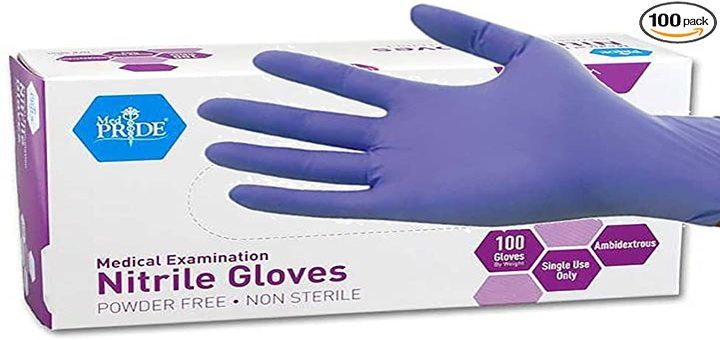
MedPride® Unisex Blue Nitrile Exam Powder-Free Exam Gloves


The MedPride gloves are iris blue nitrile exam gloves, non-sterile and single use.
- Nitrile is a synthetic material, so the gloves contain no natural rubber latex and leave no powder.
- Textured fingertips help you grip and feel what you handle.
- A beaded cuff adds durability, and the gloves fit either hand.
- The box holds 100, in sizes small to extra large.
3
X3® Unisex Black 3 Mil Latex-Free Disposable Gloves


The X3 gloves are black 3 mil nitrile gloves for light-duty tasks.
- The 3 mil nitrile is lightweight and highly elastic, and it is latex-free.
- The black color hides dirt and grease in kitchens, barber shops and cleaning work.
- They suit food service, cleaning solutions and hair dye.
- The The web box is extra large, 100 gloves.
4
ProCure® Unisex Cool Blue Nitrile 200-Count Disposable Gloves


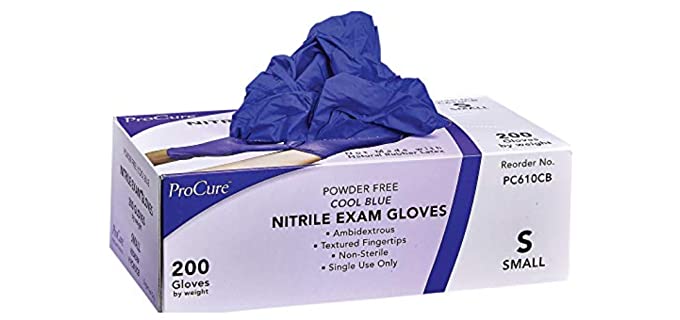
The ProCure Cool Blue gloves are powder-free nitrile gloves, 200 to a box.
- They are synthetic nitrile, made without added powder or natural rubber latex.
- The box holds 200 single-use gloves.
- The small size fits a palm width of 3.0 to 3.5 inches, so measure your palm first.
- They suit routine handling and cleanup.
5
Basic medical® Unisex Blue Nitrile Exam 1,000-Count Exam Gloves


The Basic Medical gloves are blue nitrile exam gloves sold as a case of 1,000.
- The gloves contain no natural rubber latex and are made without powder.
- The fingers are 0.12 mm thick and the palms are 0.08 mm thick, with a smooth finish.
- A case holds 10 boxes of 100 gloves.
- They suit a lab, kitchen, shop or home.
Index Table: Powder-Free Nitrile Gloves at a Glance
| No. | Product | Image | Features | Brand | Score |
|---|---|---|---|---|---|
| 1 | Safeguard Unisex Blue Nitrile - Powder-Free Food Grade Gloves |  |
| Safeguard | - |
| 2 | MedPride Unisex Blue Nitrile Exam - Powder-Free Exam Gloves |  |
| MedPride | - |
| 3 | X3 Unisex Black 3 Mil - Latex-Free Disposable Gloves |  |
| X3 | - |
| 4 | ProCure Unisex Cool Blue Nitrile - 200-Count Disposable Gloves |  |
| ProCure | - |
| 5 | Basic medical Unisex Blue Nitrile Exam - 1,000-Count Exam Gloves |  |
| Basic medical | - |
Sources
- U.S. Food and Drug Administration (FDA). Medical Gloves. Accessed October 26, 2026.
- U.S. Food and Drug Administration (FDA). Medical Device Bans. Accessed October 26, 2026.
Update History
- Oct 2026: Rewrote the article around FDA guidance on powdered gloves and latex alternatives, removed the unsourced claims that nitrile is hypoallergenic and stronger than latex, the incorrect thickness range and the old score tables, rewrote all five product notes and added Sources
- Oct 2021: Published


